
4 Innovative Event Marketing Strategies That Boost ROI
Estimated reading time:
1 minute
Get this: event marketing budgets nearly doubled between 2021 and 2023, with 73% of marketers boosting their spending. Why? Because in-person events are back — and they’re bigger than ever.
The game has changed, though. Today’s successful events are more than simple gatherings. They’re immersive experiences that blend sustainability with powerful networking opportunities.
But here’s the challenge: measuring success isn’t as simple as counting ticket sales anymore. Smart event managers are moving beyond basic metrics, embracing sophisticated tools like multi-touch attribution and predictive analytics to prove (and improve) their ROI.
When you strategically integrate the right marketing tools and analytics (which we’ll cover in detail here), you can track, measure, and improve your returns in ways that weren’t even possible a few years ago.
Let’s look at some event marketing strategies to help you get more value from every dollar that you invest.
Strategy #1: Use previous event marketing data for effective budget allocation
Imagine you’re planning your next big event. Only, instead of relying on gut feelings, you’re using data to promote it across multiple channels at just the right time. Your marketing budget is allocated based on real performance metrics, not guesswork. Smart analytics tell you exactly when to ramp up your campaigns for maximum impact, while automated tools handle repetitive tasks in the background…
But this is NOT a dream — in fact, it’s very possible!
While we can’t predict the future, we can do the next best thing: learn from the past. Smart budget allocation starts with understanding what worked (and what didn’t) in your previous events.
Let’s break this down into actionable steps. First, you’ll want to choose the right type of budgeting method and a budgeting tool based on your needs. Popular options include Freshbooks, Quicken, or Xero. Next, build a data-driven budget that works.
- Start by creating what’s called a multi-touch attribution model, i.e., tracking how people find their way to your registration page. For example, did they click on your Facebook ad, then read your email, then finally sign up? Or did they find you on a ticketing platform and register from there? Understanding this journey helps you see which marketing efforts are really paying off.
- Set up tracking across all your marketing channels. Each platform, whether it’s social media, email, or your website, has its own analytics tools that you can use to see which channels are bringing in the most registrations, versus the money spent.
- Don’t set your budget in stone. Create specific triggers that tell you when it’s time to shift money around. Maybe you notice your LinkedIn ads are bringing in twice as many registrations as your Facebook ads — that’s a signal to adjust your spending.
The goal is to optimize your spending and get the maximum bang for your buck.
Leverage AI and automation to reduce marketing costs
The awareness around having a dedicated event marketing budget is increasing, yes. But sometimes, you may need to stretch your marketing budget more than usual. During times like these, put repetitive tasks on autopilot.
Tools like Zapier and Make can easily handle time-consuming marketing tasks while you focus on strategy and creativity.
These automation tools make it very easy to connect your marketing and sales data, showing you exactly how attendees move from first hearing about your event to actually attending it.
Here are some examples of workflows that you can automate.
- When someone registers for your event, an automated workflow tracks their journey from your Facebook ad to your website to your registration form.
- Want to know how your event marketing is performing right now? Build dashboards that show you important numbers in real-time, like how much you’re spending per registration or which marketing channels are working best.
- Create custom calculators that predict your event’s success based on past performance data, factoring in things like what type of event you’re running, who your audience is, and whether certain seasons will affect your results.
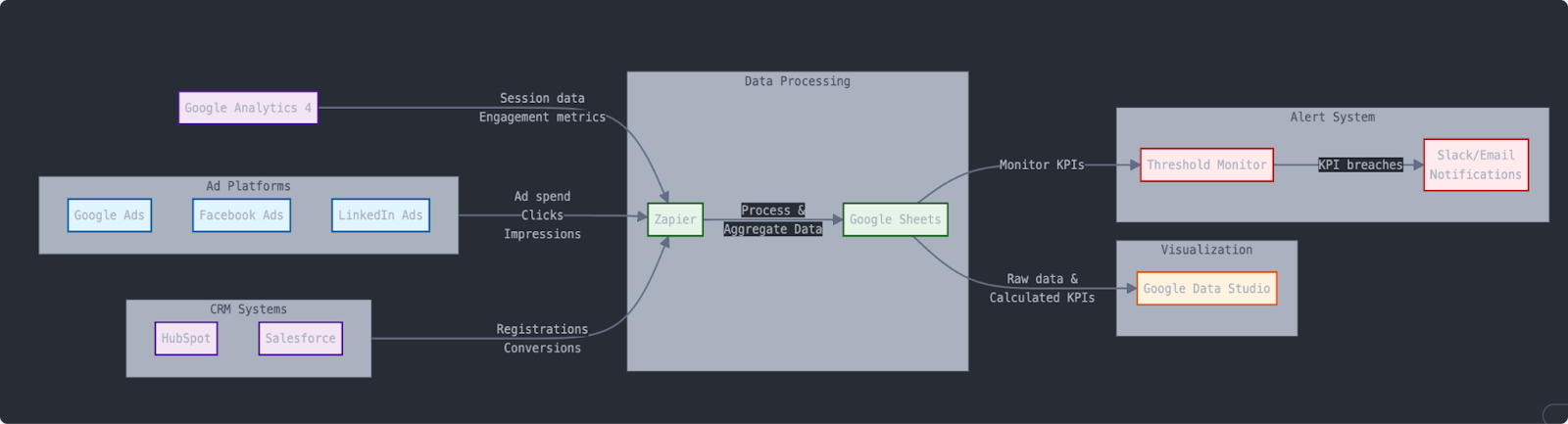
Sample Zapier Workflow for setting up real-time performance dashboards
Objective:
Create a workflow to automatically update a performance dashboard with KPIs such as cost per registration, channel ROI, and engagement rates in real time, integrating data from advertising platforms, CRMs, and analytics tools.
Tools involved:
- Google Sheets — For aggregating data.
- Google Data Studio (or Power BI/Tableau) — For dashboard visualization.
- Zapier — To automate data flow.
- Ad Platforms (Google Ads, Facebook Ads, LinkedIn Ads) — For channel ROI and ad spend.
- CRM (HubSpot, Salesforce) — For registration and engagement data.
- Analytics Tool (Google Analytics 4) — For engagement metrics.
Step-by-step workflow:
1. Track ad spend and channel ROI
- Trigger: New data in Google Ads, Facebook Ads, or LinkedIn Ads.
- Action: Zapier adds this data (e.g., spend, impressions, clicks) to Google Sheets.
- Columns: Channel Name, Ad Spend, Clicks, Impressions, Conversions, ROI.
2. Update Cost per registration
- Trigger: New registration in HubSpot or Salesforce.
- Action: Zapier calculates the cost per registration by dividing total ad spend (from Step 1) by the number of new registrations and updates it in Google Sheets.
3. Monitor engagement rates
- Trigger: New session/event tracked in Google Analytics 4 (e.g., pageviews, time on site, bounce rates).
- Action: Zapier logs this data in Google Sheets, updating engagement metrics like average session duration and conversion rate.
4. Generate real-time dashboards
- Trigger: New row added or updated in Google Sheets.
- Action: Connect Google Sheets to Google Data Studio for automatic updates to the dashboard.
- Visualize key metrics:
- Cost per registration: Line graph.
- Channel ROI: Bar chart by channel.
- Engagement rates: Pie chart or table.
- Visualize key metrics:
5. Notifications for anomalies
- Trigger: KPI thresholds breached (e.g., cost per registration exceeds $50, ROI drops below 10%).
- Action: Zapier sends an alert via Slack or email.
Workflow diagram:
Expected results:
- Real-time tracking of ad performance, cost per registration, and engagement rates.
- Automated anomaly detection with instant alerts.
- Easy-to-understand performance dashboard, accessible at any time.
Heads-up: setting up these smart workflows requires either technical know-how or a developer’s help, especially for bigger events. However, if you do have the budget to bring in someone with technical expertise, these automated systems can save you a lot of time and money in the long run.
Use predictive analytics for campaign optimization
Predictive analytics looks at patterns from your past events and current market trends to help you make better marketing decisions.
In your event marketing plan, make use of tools like:
- Eventbrite to analyze your historical attendance data to forecast how many people might show up.
- Tableau to create visual maps of your marketing journey, showing you exactly which promotional channels are bringing in the most registrations.
- Amplitude to get in-depth insights into attendee behavior, telling you who’s most likely to actually attend versus who might need an extra reminder.
Interestingly, we’re seeing a major shift toward what’s called “micro-moment marketing” in the events world. Instead of running broad campaigns, smart event marketers are targeting specific moments in the attendee journey.
For example, if you use the Promoter plugin, you can send personalized messages based on how each person has interacted with your event promotions rather than sending the same reminder email to everyone. Trust us, this precise targeting works. Event managers using this approach are seeing registration rates improve substantially compared to traditional methods.
Strategy #2: Transform your event promotion with personalized multi-channel campaigns
Promoting your event on multiple channels is all about being everywhere strategically, with personalization and perfect timing.
- Start by grouping your potential attendees based on their behavior and when they typically register. Early birds might respond best to exclusive pre-sale offers on LinkedIn, while last-minute decision-makers might need that final push through targeted Instagram ads.
- Create a content calendar that matches these patterns. Emails can go out early in the week when business professionals are planning, while social media posts can peak during weekend browsing hours.
Coordinate your timing across all channels, whether they’re ones you own (like your website), earn (like press coverage), or pay for (like ads), to create an end-to-end journey that guides attendees naturally toward registration.
Effective use of social media and email marketing for maximum reach
A whopping 5.17 billion people scrolled through social media in 2024 (Backlinko, 2024). That’s like having two-thirds of the world’s population hanging out in one digital space. Pretty wild, right?
But just blasting out event posts doesn’t cut it anymore. The real winners are diving deep into their event data to uncover the ideal posting windows. Maybe your tech crowd is most responsive during their Wednesday lunch breaks, or your weekenders browse Instagram on Sunday mornings. These insights are critical for deciding your ad spend.
Tap into what we call “mirror audiences.” If your last conference was packed with IT directors who loved it, platforms like Facebook and LinkedIn can help you find more people who match that same profile.
Get press coverage. When industry blogs or news sites feature your event, their shares spark conversations that money can’t buy.
And don’t give up on email marketing for event promotions. It’s your chance to reconnect with folks who showed interest but got distracted. Mix in some well-timed social media reminders, and you’ve got a powerful combo that turns “maybe next time” into “count me in.”
Partner with influencers and industry experts
Emplifi’s 2023 report shows that teaming up with influencers can skyrocket your reach by 18 times in healthcare and real estate events, and 14 times in beauty industry gatherings. Now, before you dash off to DM every influencer in sight, let’s get smart about this.
Ditch the guesswork when picking partners. Look at hard data like engagement rates, not just follower counts. That tech guru with 10,000 super-engaged followers might pack more punch than a celebrity with millions of passive ones.
Track your influencer campaigns like you’d track your investments. Set up clear metrics — registration spikes after their posts, hashtag usage, or attendee surveys mentioning their content.
A good idea is to get your influencers involved in crafting the message. When they help shape the story, their promotions feel genuine, not forced. Maybe they host a pre-event webinar or share behind-the-scenes peeks at the planning process. Their audience can smell authenticity from a mile away, and they’ll appreciate the real deal.
Create compelling content that converts attendees
Ever heard of the “48-hour magic window”? Research shows that most folks jump on event registrations either in the first 48 hrs after you announce them or 48 hrs before early bird prices close.
Knowing this, smart event planners sprinkle their best content during these hot zones. Share those glowing testimonials from last year’s rock star attendees — you know, the ones who landed dream clients or cracked the code to their biggest business challenges at your event.
Nothing sells tickets like real success stories.
Build excitement with some FOMO-inducing offers —VIP access for the first 50 signups, or exclusive workshop seats for early birds. If you notice that someone’s been frequently visiting your events page but hasn’t signed up yet, give them that extra nudge — maybe a sneak peek at your speaker lineup or a special discount code. Just make it feel personal, not pushy.
Most importantly, make sure your registration process is smoother than butter. Test every click and tweak every page to watch those conversion rates soar.
Strategy #3: Use innovative hybrid experience design for personalization
The numbers don’t lie: organizations that master personalized hybrid experiences see 37% higher engagement rates, according to American Express’s 2024 Global Meetings & Events Forecast report. That’s what happens when you thoughtfully blend physical and digital elements.
Successful hybrid events create authentic touchpoints between in-person and virtual attendees. Here’s how leading organizations are making it happen:
- Smart badge technology: Physical attendees wear badges with embedded NFC chips that track session attendance and interests, while virtual attendees have digital profiles that mirror these capabilities.
- AI-powered matchmaking: Machine learning algorithms analyze attendee profiles, session choices, and real-time behavior to suggest relevant connections, whether they’re in the room or joining remotely.
- Interactive content delivery: Using platforms that automatically adjust content formats based on how attendees participate, you can deliver high-definition video streams to remote viewers while optimizing in-room displays for those present.
Here’s how it can work in real life: An executive in New York joins your keynote session while collaborating with her teammate watching from London. Their event apps suggest relevant sessions based on their industry roles and past interactions.
During panel discussions, questions flow naturally between the room and remote participants, making location irrelevant to the conversation.
The ultimate goal here is not to run two parallel events (one physical, one virtual) but to create a single, cohesive experience.
Strategy #4: Engage attendees throughout the event lifecycle
Your event shouldn’t fizzle out when the last session ends. Smart marketers turn single events into year-round communities that buzz with activity, ideas, and connections. Here are a few ideas to get started:
- Give attendees an exclusive digital hangout. A private LinkedIn group or dedicated Slack channel becomes their go-to spot for continuing those hallway conversations that sparked during the event. When an attendee from Austin can bounce ideas off a peer in Amsterdam months after meeting at your conference, you’ve created lasting value.
- Make it easy for everyone to revisit the good stuff. Set up a content hub where attendees find session recordings, slides, and bonus materials. But don’t just dump content there. Organize themed series that build on popular event topics. When that marketing director needs to reference that brilliant strategy presentation three months later, they’ll thank you.
- Turn your biggest fans into event ambassadors. These engaged attendees already rave about your event; give them early access to news, special perks, and chances to lead community discussions. Their enthusiasm is contagious, and their insights help shape future events.
- Keep the momentum rolling on social media. Create event-specific hashtags that live on well past the closing remarks. Schedule regular live sessions where past speakers drop by to share updates. Post weekly discussion prompts that get people talking. When you maintain this steady level of engagement, you slowly build a thriving community that gets more valuable with time.
Send post-event feedback and thank-you emails
In the first 24 hours after your event, while the excitement is still fresh, reach out with a warm, personal thank-you email. Ask for their thoughts.
What lit them up? What fell flat? Their honest feedback can make your next event even better.
Between major events, keep the energy alive with bite-sized gatherings. Monthly virtual coffee chats with industry experts, quick-fire workshop sessions, or casual networking hours keep your community connected and engaged.
Want to turn first-timers into regulars? Launch a loyalty program that means business. Early registration access, VIP seating, one-on-one time with speakers — these perks make attendees feel valued and eager to return.
Plus, when they see their feedback implemented in future events, they become a part of your event’s evolution.
Streamline your ROI, one strategy at a time
The path to maximizing event ROI isn’t about implementing all these strategies at once. Start by choosing one or two approaches that align best with your current capabilities and goals. Monitor your metrics, gather feedback, and refine your approach with each event.
As you build your tech stack, focus on tools that integrate well with each other, provide clear analytics, and support your business goals.
Most importantly, stay flexible and adaptive. The events industry continues to evolve, and so should your marketing strategies.Need more event marketing insights? Sign up for our newsletter to get expert advice on event planning and management.

Nathan
View author page